Copper cents from the mid-1960s often create confusion. Some even look at 1996 penny value lists and expect similar behavior from earlier Memorial cents. That comparison does not work.
The 1966 Lincoln cent is not rare by itself. It was struck in large numbers. It contains no silver. On paper, it looks ordinary.
Yet some 1966 pennies sell for far more than face value. So, here we would like to clear things up and check if real premiums appear.
Feature | Detail |
Year | 1966 |
Mint Mark | None (mint marks suspended) |
Composition | 95% copper, 5% tin & zinc |
Weight | 3.11 g |
Diameter | 19.05 mm |
Edge | Plain |
Obverse | Abraham Lincoln |
Reverse | Lincoln Memorial |
Before discussing price, start by checking these fundamentals.
The absence of a mint mark is normal. During the mid-1960s coin shortage, the Mint removed mint marks to reduce hoarding. All regular 1966 cents look the same in that regard.
Total production exceeded two billion pieces. That number explains the coin’s availability today. Most examples remain common in circulated condition. The 1966 cent is not a key date and not a semi-key issue.
If the date is common, where does the value begin?
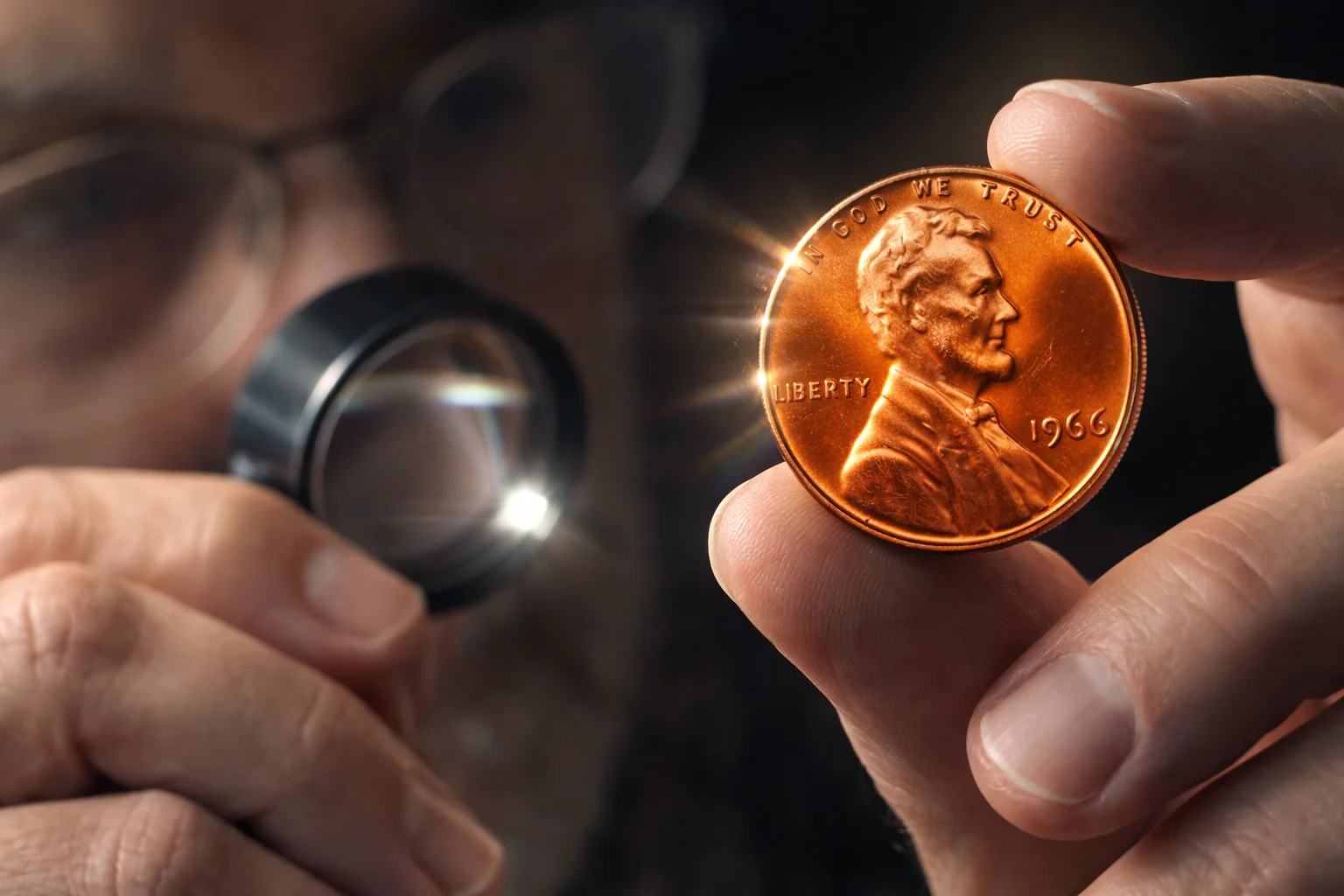
The year alone does not create a premium. Market price depends on survival in high condition and on distinct minting mistakes.
Three elements control the market:
Grade.
Color.
Confirmed errors.
Collectors who ignore these factors often overestimate worn examples. A circulated 1966 cent is usually worth one cent. A sharply preserved Mint State red example behaves very differently.
Most 1966 cents circulated for decades. They show wear on Lincoln’s cheek and jaw. The hair above the ear softens first. Coat folds fade. On the reverse, Memorial columns lose separation.
Circulated pieces are easy to find. True Mint State examples are not rare, but they are less common than worn coins.
The difference between grades becomes critical at higher levels.
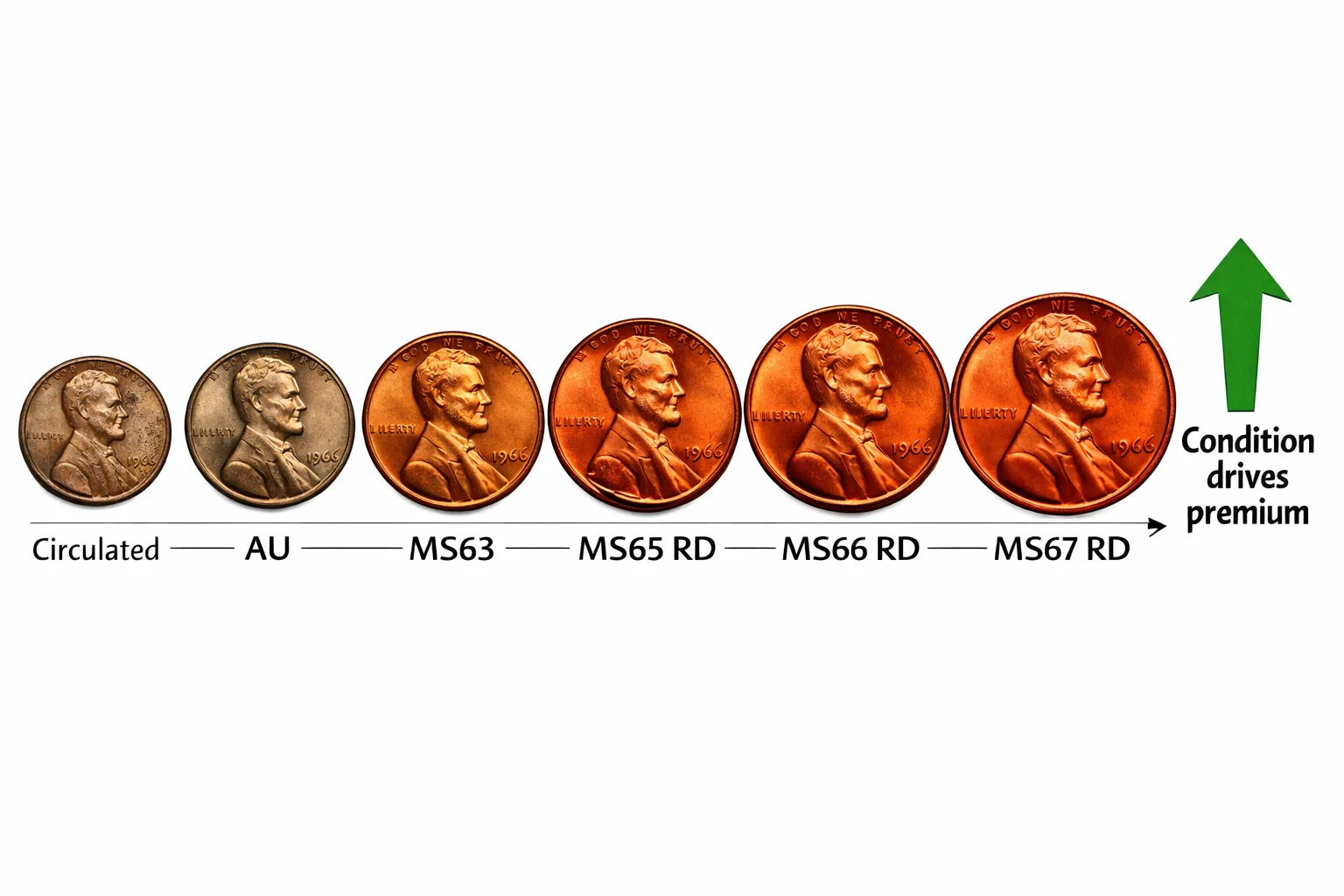
An MS63 coin may show visible contact marks and average luster. An MS65 example looks cleaner and brighter. At MS66 and above, surface quality becomes strict. Small ticks can reduce value sharply.
Registry collectors compete for high-grade red coins. That demand pushes premiums upward. The jump between MS65 RD and MS66 RD can be significant. The difference between MS66 and MS67 may double the price.
These price jumps have nothing to do with the year. They reflect scarcity in condition.
Below are general market ranges for normal 1966 cents without dramatic errors.
Grade | Typical Range |
Circulated | Face value |
AU | $1–$2 |
MS60–63 BN | $3–$8 |
MS64–65 BN | $10–$20 |
MS65 RD | $30–$60 |
MS66 RD | $75–$150+ |
MS67 RD | Market dependent |
Circulated coins rarely exceed face value. Modest Mint State examples bring small premiums. The strongest movement appears in high-grade red coins. The market rewards quality, not age.
Copper reacts to air. Over time, its surface darkens. Collectors classify uncirculated copper cents by color.
Brown (BN)
Fully toned brown surface. The original red color has faded. These pieces carry the lowest premium within Mint State levels.
Red Brown (RB)
Mixed red and brown surfaces. Some original color remains. Moderate premium.
Red (RD)
Strong original red across most of the surface. Highest premium in higher grades.
Color matters most in Mint State. An MS65 BN example may sell for a modest amount. An MS65 RD can trade for several times more. The difference lies in originality.
Natural luster flows in circular patterns across the surface. Original red copper reflects light evenly. Artificial brightness looks different. It lacks depth and texture.
When a coin is cleaned, surface metal is disturbed. Fine lines appear. Luster breaks. The coin may look bright at first glance, but experienced collectors detect alteration quickly. Market interest declines once cleaning is noticed.
Original surfaces carry more weight than shine.
Date value is limited. The error value can be real. Below is a summary of recognized varieties.
Error Type | What to Look For | Market Range* |
Doubled Die Obverse (FS-101) | Strong doubling on date and lettering | $50–$150+ |
Doubled Die Reverse | Doubling in UNITED STATES OF AMERICA | $40–$150+ |
Lamination Error | Peeling or split metal surface | $20–$120+ |
Struck Through Grease | Missing or faint letters/date | $10–$60 |
Broadstrike / Off-Center | Wider coin or shifted design | $25–$150+ |
“L” on Rim | The letter pushed toward the rim | Usually minor |
*Values depend on grade, clarity, and demand.
Doubled Die Obverse
Look for separation in LIBERTY and in the date. True doubled dies show distinct outlines. The effect appears raised and is part of the design.
Machine doubling looks flat and shelf-like. It is common and usually carries little premium. Strong, clear doubling attracts specialists.
Doubled Die Reverse
Reverse doubling often appears in UNITED STATES OF AMERICA. The letters may show separation or extra thickness.
Bold examples receive attention. Weak or questionable cases bring little interest. Clarity determines value.
Lamination Errors (“Wounded” Areas)
Lamination errors occur when the metal alloy does not bond evenly. The surface may peel or split. Some examples show a streak or tear across Lincoln’s head, creating a dramatic look.
The stronger and cleaner the lamination, the better the premium. Minor surface defects do not qualify.
Struck Through Grease
Grease or debris on the die can fill design recesses. Letters appear weak or partially missing. In strong cases, parts of the date or motto fade noticeably.
Light examples are common. Only clear, dramatic cases bring attention.
Broadstrike and Off-Center Errors
A broadstrike occurs when the coin is struck outside the retaining collar. The result is a slightly wider coin with a distorted rim.
Off-center strikes shift the design away from the center, leaving blank planchet space. Larger shifts create stronger premiums.
The “L” on Rim Situation
Some 1966 cents show the “L” in LIBERTY touching or crossing into the rim area. This is usually the result of a slight off-center strike.
Many of these examples are overstated. Only clearly misaligned pieces carry noticeable premiums.
Correct identification prevents mistakes. Confirm year, composition, and overall type before judging condition or error status.
A reliable coin scanner app can assist with basic verification. Coin ID Scanner helps confirm specifications, identify type, and store coins digitally in a collection. It provides technical data quickly. It does not replace grading skills or determining mistakes, but it reduces misidentifications.
After confirmation, inspect surfaces under proper light. Look for luster flow. Examine high points for wear. Check suspected doubling carefully. Do not confuse damage with mint errors.
Most examples remain common. They are not rare by date. They do not carry melt premiums. The 1966 Lincoln cent is not a key or semi-key date. Massive production limits scarcity, and they do not carry melt premiums.
Value appears in specific cases:
Strong Mint State preservation.
Full red color in higher grades.
Clear, verified mint errors.
Without those factors, the coin remains common. However, the coin is good for beginners. The 1966 issue demonstrates how value forms in high-mintage copper coins: condition drives premium, and color amplifies it. Errors add a separate layer of interest.